This is it. This is the bag I've chosen to use exclusively for one entire month. The Ortlieb Velocity.
Ortlieb, as the name may or may not suggest, is a German company. They are most famous for their panniers, which have long been the golden standard in urban bike transport. Waterproof, functional, and incredibly stylish, Ortlieb products are popular among everybody from office commuters to bike messengers to even motorcycle tourers.
The Velocity the small bag in Ortlieb's line of messenger backpacks. With a capacity of 20L, it is slightly smaller in capacity than a Chrome Citizen or Buran, but slightly larger than a Timbuk2 medium sized messenger. It is made out a waterproof performance fabric, which is basically a urethane rubber layer on top of a clothlike Nylon fabric. Totally waterproof, and it has an interesting look. Not the bright vivid colors of Cordura, but it's not quite shiny like fresh urethane.
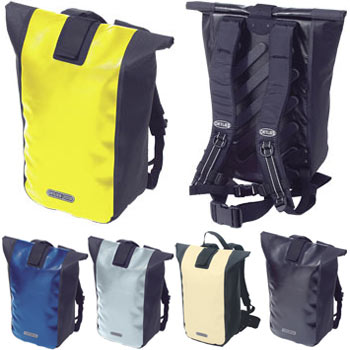
The waterproof nature of the fabric is supplemented by the roll-top enclosure. There is a small rigid plastic bar at the end of the opening, which gives something to grip while you roll down the top. This lets you get an incredibly tight roll, and definitely prevents water from getting in. I've seen people submerge their Ortlieb rolltop bags and panniers and come out fine, although they are not necessarily designed that way. Nonetheless, the Velocity will definitely hold up in the heaviest of rainstorms.
There is very little (if anything) in the way of pockets in the main compartment. A rigid board backing is an ingenious way of preventing sharp objects from poking you in the back. This also means you don't have to really think about the order in which you pack the bag. Although it is not space efficient, the board gives the bag an incredible degree of structure. You can literally throw everything you need into the bag, and it'll work out. Awesome.
The back panel of the backpack is closed cell foam. Super stiff with very little give, so it doesnt have a disconcertingly squishy feel. Instead, the purpose of the foam is diffuse a little shock, but also to hold open a channel for air across your back. This prevents the "sweaty back" that many messenger bags result in. Although the weather is getting colder, sweaty back definitely remains a problem. Kudos to Ortlieb for coming up with a solution for it.
The Velocity is just an incredibly solid and well constructed bag. I chose it because of this, but also because of its simplicity. There were two ways that I could have taken One Bag, One Month. One way would have been to use an incredibly complex bag (the Shed, for example). That way, I wouldn't get bored with the bag. The approach I have chosen to take with the Ortlieb, though, reflects a more simple way of approaching portage. Your choice of bag SHOULDN'T be something you think about everyday. Rather, your bag should be an extension of what you need to carry. You use bags to carry things, not to use their features. I definitely feel that a simpler approach to carrying things is definitely an improvement.
Stay tuned as I give regular updates on my progress through One Bag, One Month. I might go crazy. I sure hope not.
Wednesday, September 14, 2011
Monday, September 12, 2011
Bag Profile: Chrome Buran
This is one of the other top contenders for One Bag, One Month. The Chrome Buran is Chrome's entry into the high end laptop messenger market. Designed to contend with such bags as the Timbuk2 D-Lux Messenger, the Buran's unique sell is that it combines the ergonomics of Chrome's medium size Citizen messenger bag with an integrated laptop sleeve and more substantial pockets, making it slightly more suitable for a business/professional setting. At the same time, however, Chrome strives to maintain the solid rideability of the Buran.
A thing to note about the Buran is that has been revised once without a name change. The older Buran had a different laptop sleeve location, a convertible strap pad, no seatbelt buckle release, and some other small changes. After receiving negative feedback about the aforementioned properties, Chrome released a revision of the Buran (aptly referred to by some stores as the Buran II). This revision is what I have.
The Buran's unique feature is its integrated laptop sleeve. It takes a more traditional approach to laptop storage, offering a fairly well padded zipped sleeve mounted against the back wall. This is in contrast to the first Buran, which placed the sleeve against the front wall, which is identical to the placement of the laptop sleeve retaining straps on Chromes newer Buckle Bags.
The Buran's shape is also slightly different than the Citizen buckle bag. Whereas the Citizen can be described as a trapezoid in shape, the Buran is far more rectangular. For some reason, I find that it looks more professional. However, the disadvantage of this shape is that it creates a more "boxy" sensation when filled, whereas the Citizen always felt a little more tight on the back.
Chrome also added a significant selection of pockets to the Buran, solidly placing it as a "business bag". There are two front cargo pockets (although they are not accessible with the main compartment closed, as Mission Workshop bags are), as well as a compartment for pens and small stationery. The latter pocket is somewhat concealed and excessively flat, which limits its utility as a place for quick access objects. The cargo pockets in the front are plenty large and slightly 3d, so they hold a good amount of stuff.
The buckles on the Buran are all fairly high quality. There is noticeable play in the main seat belt buckle, which is slightly disconcerting. I have not noticed this on any other Chrome bags. Of note are the buckles that secure the flap down. They are actually located under the strap, not over it as they are on buckle bags.
The Buran's great strength is its scalability. It is a very rigid bag by itself, and more so when the laptop sleeve is filled with some books or other flat objects. It has absolutely no problem carrying small loads. The footprint is basically the same as when it carries larger loads. Although some (myself included) may find the boxy profile somewhat uncomfortable, it is terrific at scaling to loads.
I have my personal reservations about the Buran. It is a great bag on paper. It has the complexity to keep me interested, and the build quality is, of course, second to none. However, as it is executed, it seems ill-equipped for the way that I intend to use it for One Bag, One Month. I rarely, if ever, carry a laptop or many other flat hard objects. I tend to carry softer things, like my bike shoes and extra clothes. Furthermore, the slightly boxy profile does bug me a bit, although I can't quite explain why. If I ever had a cushy job that required me to carry lots of papers and a laptop and commute using a city bike in a flat area, then the Buran would probably be my first choice.
A thing to note about the Buran is that has been revised once without a name change. The older Buran had a different laptop sleeve location, a convertible strap pad, no seatbelt buckle release, and some other small changes. After receiving negative feedback about the aforementioned properties, Chrome released a revision of the Buran (aptly referred to by some stores as the Buran II). This revision is what I have.
The first version of the Chrome Buran
The Buran's unique feature is its integrated laptop sleeve. It takes a more traditional approach to laptop storage, offering a fairly well padded zipped sleeve mounted against the back wall. This is in contrast to the first Buran, which placed the sleeve against the front wall, which is identical to the placement of the laptop sleeve retaining straps on Chromes newer Buckle Bags.
The Buran's shape is also slightly different than the Citizen buckle bag. Whereas the Citizen can be described as a trapezoid in shape, the Buran is far more rectangular. For some reason, I find that it looks more professional. However, the disadvantage of this shape is that it creates a more "boxy" sensation when filled, whereas the Citizen always felt a little more tight on the back.
Chrome also added a significant selection of pockets to the Buran, solidly placing it as a "business bag". There are two front cargo pockets (although they are not accessible with the main compartment closed, as Mission Workshop bags are), as well as a compartment for pens and small stationery. The latter pocket is somewhat concealed and excessively flat, which limits its utility as a place for quick access objects. The cargo pockets in the front are plenty large and slightly 3d, so they hold a good amount of stuff.
The buckles on the Buran are all fairly high quality. There is noticeable play in the main seat belt buckle, which is slightly disconcerting. I have not noticed this on any other Chrome bags. Of note are the buckles that secure the flap down. They are actually located under the strap, not over it as they are on buckle bags.
The revision of the Buran. Note the buckle placement.
The Buran's great strength is its scalability. It is a very rigid bag by itself, and more so when the laptop sleeve is filled with some books or other flat objects. It has absolutely no problem carrying small loads. The footprint is basically the same as when it carries larger loads. Although some (myself included) may find the boxy profile somewhat uncomfortable, it is terrific at scaling to loads.
I have my personal reservations about the Buran. It is a great bag on paper. It has the complexity to keep me interested, and the build quality is, of course, second to none. However, as it is executed, it seems ill-equipped for the way that I intend to use it for One Bag, One Month. I rarely, if ever, carry a laptop or many other flat hard objects. I tend to carry softer things, like my bike shoes and extra clothes. Furthermore, the slightly boxy profile does bug me a bit, although I can't quite explain why. If I ever had a cushy job that required me to carry lots of papers and a laptop and commute using a city bike in a flat area, then the Buran would probably be my first choice.
Saturday, September 10, 2011
Bag Profile: Mission Workshop Shed
I use this bag alot, and I mean alot. It's all I've used for the last week. Why? Quite simply, it's one of THE top contenders for One Bag, One Month. Read on to find out why.
Mission Workshop is run by the guys who started Chrome. History being history, they left Chrome and started another company: Mission Workshop. Located in the same part of San Fran as Timbuk2, Mission Workshop bags take a different approach to portage than Chrome does. Instead of a minimalist carryall approach, their bags tend to have a plethora of pockets. but not excessively so. Muted and subtle color schemes take the place of the flashy and bright colors that Chrome is noted for. Finally, (and this is the real plus for me) the bags take literally the concept of "scalability": the backpacks can actually expand to take whatever you want to carry, and the messenger bags can do something very similar.
The Shed is the largest of Mission Workshop's line of messenger bags. Even more so than Chrome's buckle bags, they take the "one design fits all" approach. The base model of the Shed is the only one that Mission Workshop sells. Different sizes are scaled geometrically. Their shapes and features are completely identical.
The signature feature of the Shed is the rolltop convertability. It is the only single strap bag I have ever seen that allows the user to roll the top down and secure it with velcro. The great advantage of this mode is that the front pockets (which are also quite well designed, being 3-dimensional and waterproofed with a gusset type overlap) are accessible when the top is rolled down. The quick access nature of these pockets makes it great for food, tools, and small bike accessories. I usually keep my gloves, deodorant, and bike pump in one pocket, with the other being reserved for food. The roll-top compartment is also exceedingly waterproof, having not only standard Cordura with tarp liner, but a large section of it rolled together.
You can also use the bag as a standard messenger, folding it over. I find this works alot better for large loads. Indeed, Mission Workshop seems to believe so too, as they designed the straps for buckles for the messenger mode to be exceedingly long. So long, in fact, that they trail quite prominently when in rolltop mode. The buckles that the straps click into are also positionable. You can move them towards the top for smaller loads, or you can max out the capacity by moving them downwards. When not in use as a standard messenger, the buckles clip into the front cargo pockets, keeping them shut in rolltop mode.
There is also a laptop pocket slyly ensconced between the main compartment and cargo pockets. Its location, in addition to the urethane coated zipper that grants access to it, ensures maximum waterproofing and protection from impacts. The laptop pocket, also, is in fact actually three pockets. Made out of waterproof X-Pac fabric, one pocket is clearly for a laptop and other electronics, boasting an incredibly degree of waterproofing. There are however, more pockets inside of the laptop compartment. Some are good for pens and pencils. I like to keep my notebook in another, again because it is quite waterproof.
The strap pad of the Shed is also quite notable in that it can switch shoulders. Most bags, Chrome included, require that you choose a shoulder orientation when you purchase the bag. Righties prefer the left shoulder, and vice versa. But the Shed has an incredibly clever velcro strap that lets you change the shoulder orientation of the bag. I don't think i'll ever use it, but it is a clever innovation. The strap pad itself is quite comfortable, and just a bit short. My phone holster was accessible and usable with all but the largest loads.
Ergonomically, I find the Shed to work best with voluminous, but less heavy loads. Great for clothes and some books, but introducing heavy electronics into the main compartment makes it a bit heavy. The Shed is incredibly scalable, probably more so than any other bag I have. Small to medium loads can use the rolltop configuration, while large loads work best with the messenger configuration (including movable buckles!!!). Like alot of bags, it takes a little bit of jostling to find a comfortable angle for hard objects in the main compartments, but once that angle is found, objects definitely tend to stay there.
The most significant ergonomic problem is quite an interesting one. The rolltop configuration of this bag necessitates an incredibly TALL top flap. So tall, in fact, that reaching into the bag without taking it off is difficult. I had to angle my arm around the top of the bag to root around the main compartment. In the end, I ended up placing quick use items in the front pockets. However, this means that whenever I go to a place to do something, the first thing I do is take the bag off. This is not a problem for school classes, but it might not be the best choice for somebody that needs frequent access to larger items (photographers, for example).
All things aside, the Shed is an incredible bag. It definitely has an impressive pedigree, and the incremental improvements that the makers have incorporated into it result in an incredibly polished product. Although it tips the scales at a slightly expensive $189, that money gets you incredible quality, and years of experience.
Mission Workshop is run by the guys who started Chrome. History being history, they left Chrome and started another company: Mission Workshop. Located in the same part of San Fran as Timbuk2, Mission Workshop bags take a different approach to portage than Chrome does. Instead of a minimalist carryall approach, their bags tend to have a plethora of pockets. but not excessively so. Muted and subtle color schemes take the place of the flashy and bright colors that Chrome is noted for. Finally, (and this is the real plus for me) the bags take literally the concept of "scalability": the backpacks can actually expand to take whatever you want to carry, and the messenger bags can do something very similar.
The Shed in Rolltop configuration
The Shed is the largest of Mission Workshop's line of messenger bags. Even more so than Chrome's buckle bags, they take the "one design fits all" approach. The base model of the Shed is the only one that Mission Workshop sells. Different sizes are scaled geometrically. Their shapes and features are completely identical.
The signature feature of the Shed is the rolltop convertability. It is the only single strap bag I have ever seen that allows the user to roll the top down and secure it with velcro. The great advantage of this mode is that the front pockets (which are also quite well designed, being 3-dimensional and waterproofed with a gusset type overlap) are accessible when the top is rolled down. The quick access nature of these pockets makes it great for food, tools, and small bike accessories. I usually keep my gloves, deodorant, and bike pump in one pocket, with the other being reserved for food. The roll-top compartment is also exceedingly waterproof, having not only standard Cordura with tarp liner, but a large section of it rolled together.
You can also use the bag as a standard messenger, folding it over. I find this works alot better for large loads. Indeed, Mission Workshop seems to believe so too, as they designed the straps for buckles for the messenger mode to be exceedingly long. So long, in fact, that they trail quite prominently when in rolltop mode. The buckles that the straps click into are also positionable. You can move them towards the top for smaller loads, or you can max out the capacity by moving them downwards. When not in use as a standard messenger, the buckles clip into the front cargo pockets, keeping them shut in rolltop mode.
You can also use it as a standard messenger
There is also a laptop pocket slyly ensconced between the main compartment and cargo pockets. Its location, in addition to the urethane coated zipper that grants access to it, ensures maximum waterproofing and protection from impacts. The laptop pocket, also, is in fact actually three pockets. Made out of waterproof X-Pac fabric, one pocket is clearly for a laptop and other electronics, boasting an incredibly degree of waterproofing. There are however, more pockets inside of the laptop compartment. Some are good for pens and pencils. I like to keep my notebook in another, again because it is quite waterproof.
The strap pad of the Shed is also quite notable in that it can switch shoulders. Most bags, Chrome included, require that you choose a shoulder orientation when you purchase the bag. Righties prefer the left shoulder, and vice versa. But the Shed has an incredibly clever velcro strap that lets you change the shoulder orientation of the bag. I don't think i'll ever use it, but it is a clever innovation. The strap pad itself is quite comfortable, and just a bit short. My phone holster was accessible and usable with all but the largest loads.
The aforementioned velcro strap. Also, their logo.
Ergonomically, I find the Shed to work best with voluminous, but less heavy loads. Great for clothes and some books, but introducing heavy electronics into the main compartment makes it a bit heavy. The Shed is incredibly scalable, probably more so than any other bag I have. Small to medium loads can use the rolltop configuration, while large loads work best with the messenger configuration (including movable buckles!!!). Like alot of bags, it takes a little bit of jostling to find a comfortable angle for hard objects in the main compartments, but once that angle is found, objects definitely tend to stay there.
The most significant ergonomic problem is quite an interesting one. The rolltop configuration of this bag necessitates an incredibly TALL top flap. So tall, in fact, that reaching into the bag without taking it off is difficult. I had to angle my arm around the top of the bag to root around the main compartment. In the end, I ended up placing quick use items in the front pockets. However, this means that whenever I go to a place to do something, the first thing I do is take the bag off. This is not a problem for school classes, but it might not be the best choice for somebody that needs frequent access to larger items (photographers, for example).
All things aside, the Shed is an incredible bag. It definitely has an impressive pedigree, and the incremental improvements that the makers have incorporated into it result in an incredibly polished product. Although it tips the scales at a slightly expensive $189, that money gets you incredible quality, and years of experience.
Wednesday, September 7, 2011
Bag Profile: Chrome Metropolis
Oh Chrome... Your bags are so so attractive.
That's definitely the first thing that comes to mind when thinking about the Chrome Metropolis. It's definitely the little things that count, even if you don't notice them, and boy... the Metropolis is packed with polished little details.
The Metropolis is the largest of Chrome's most famous line of messenger bags. You know, the kind with the seatbelt buckle upfront and the distinguishably bright red griffin logo on the back. Along with the Citizen and Mini-Metro, the Metropolis arguably sets the standard for what a high end messenger bag actually constitutes.
The shape it takes is vaguely similar to a parallelogram from the front, and an envelope in design. The flap folds over the inside front with a little bit of overlap to maintain water proof-ness. You can detach the Cordura from the truck tarp liner, allowing you to segregate your wet items from your dry ones (those little touches).
The strap pad is equally famous. As opposed to the convertible strap pad of a Timbuk2, the strap pad on the Metropolis is fixed, so you're stuck with the strap on one side. The advantage to this design is that you can design the strap to be specific to the left (or right shoulder) and maximize comfort. That is definitely the case on the Metropolis. One side of the strap pad seems to be lower than the other, anticipating the uneven distribution of heavy loads. I can think of no way to replicate this for the other shoulder without using a fixed strap.
The other advantage of the Metropolis' strap pad is that it actually quite long. The bag is definitely most comfortable with the buckle located about mid-chest, and the strap pad is long enough to achieve that even for me (I am quite thick chested). This means the lowest part of the accessory strap hovers just below the collarbone and is actually accessible on the go (again, those little touches).
Where the Metropolis struggles a little bit is in scalability and ergonomics. The design of the bag doesn't give alot of space for emptiness. That is, when the bag is only lightly loaded, it feels like something is wrong with the bag. I found myself padding the empty space with something springy, like a jacket. Gives it a little more volume and fills it out.
I also found that the Metropolis had a tendency to allow items to shift as you move around. When riding my bike, if I switched from the hoods to the drops really quickly, invariably, one of the sharper objects in my bag would tilt inwards and start poking me in the back. I was able to replicate this behavior by just fidgeting around when walking, or breaking into a slow run.
Of course, padding and larger loads will solve these problems for the most part, as will the universal precaution of smart packing. The fact remains, however, that the Metropolis truly does work best with larger , more voluminous loads. If you don't carry alot of stuff daily, or have back problems, the Metropolis is probably not your best bet. However, if you have an average to large size daily carry and bike alot, the Metropolis will definitely work well.
That's definitely the first thing that comes to mind when thinking about the Chrome Metropolis. It's definitely the little things that count, even if you don't notice them, and boy... the Metropolis is packed with polished little details.
The Metropolis is the largest of Chrome's most famous line of messenger bags. You know, the kind with the seatbelt buckle upfront and the distinguishably bright red griffin logo on the back. Along with the Citizen and Mini-Metro, the Metropolis arguably sets the standard for what a high end messenger bag actually constitutes.
The shape it takes is vaguely similar to a parallelogram from the front, and an envelope in design. The flap folds over the inside front with a little bit of overlap to maintain water proof-ness. You can detach the Cordura from the truck tarp liner, allowing you to segregate your wet items from your dry ones (those little touches).
The strap pad is equally famous. As opposed to the convertible strap pad of a Timbuk2, the strap pad on the Metropolis is fixed, so you're stuck with the strap on one side. The advantage to this design is that you can design the strap to be specific to the left (or right shoulder) and maximize comfort. That is definitely the case on the Metropolis. One side of the strap pad seems to be lower than the other, anticipating the uneven distribution of heavy loads. I can think of no way to replicate this for the other shoulder without using a fixed strap.
The other advantage of the Metropolis' strap pad is that it actually quite long. The bag is definitely most comfortable with the buckle located about mid-chest, and the strap pad is long enough to achieve that even for me (I am quite thick chested). This means the lowest part of the accessory strap hovers just below the collarbone and is actually accessible on the go (again, those little touches).
Where the Metropolis struggles a little bit is in scalability and ergonomics. The design of the bag doesn't give alot of space for emptiness. That is, when the bag is only lightly loaded, it feels like something is wrong with the bag. I found myself padding the empty space with something springy, like a jacket. Gives it a little more volume and fills it out.
I also found that the Metropolis had a tendency to allow items to shift as you move around. When riding my bike, if I switched from the hoods to the drops really quickly, invariably, one of the sharper objects in my bag would tilt inwards and start poking me in the back. I was able to replicate this behavior by just fidgeting around when walking, or breaking into a slow run.
Of course, padding and larger loads will solve these problems for the most part, as will the universal precaution of smart packing. The fact remains, however, that the Metropolis truly does work best with larger , more voluminous loads. If you don't carry alot of stuff daily, or have back problems, the Metropolis is probably not your best bet. However, if you have an average to large size daily carry and bike alot, the Metropolis will definitely work well.
Not me. I would have the buckle much lower.
Tuesday, September 6, 2011
Bag Profile: Timbuk2 D-Lux Messenger Medium
Timbuk2 is one of the more well-known high end messenger bag brands. They are one of the older brands out of San Francisco, and have their roots in the Mission district. It's not surprising that their draw encompasses not only utility, but a certain kind of lifestyle. You can definitely find those small touches in their products.
The D-Lux Messenger is Timbuk2's top of the line messenger bag meant in some way for cycling. I say this because they also make the Command messenger and the Commute series, which are more suited for travelling and laptop commuting, respectively. The D-Lux, while it can definitely carry out both of these tasks with competence, has those small touches that optimize it for use on the bike.
Simply put, the D-Lux messenger has nearly every feature that Timbuk2 has ever put on a messenger bag, and some that it has never used. They are all quite well thought out, but the confluence of all of these features somewhat detracts from the overall functionality of the bag. More on that below.
The most noticeable structural improvement that Timbuk2 has added to this bag is a different velcro placement on the inside front face of the bag (the part that attaches to the flap. There is large strip of velcro on the flap, and two parallel strips on the inside front face. Normal bags usually use four matched strips on velcro. The advantage of the new system is that you don't necessarily have to reset the flap perfectly to have a secure closure. Because the two strips don't match up, you can slant the velcro interface without compromising the hold.
Two other cool features are the compression straps on the bottom and the quick release cam buckle. These two incredibly clever innovations greatly add to the usability of the bag. The compression straps, for example, basically provides you with a bag that is infinitely scalable. You make the bag as deep as you need it to be. The quick release cam buckle also aids in scalability. You can greatly increase the amount of material you can comfortably carry without straining your neck taking the bag off. Instead, you just disengage the buckle and use the extra strap length to make it over your neck.
A feature that comes with good intentions but I feel could have been better designed is the internal strap system for accessories. The basic idea is identical to the on-strap accessory hardpoints, but inside the bag. Timbuk2 includes a rigid organizer and pen pocket insert with the bag, but they also encourage you to use your own accessories. They attach to the inside just as they attach to the strap: using a velcro flap that clamps around the webbing.
The problem with this system is that it is REALLY heavy. Timbuk2's rigid webbing is great for the strap, but it weighs the front of the bag inward, especially with accessories attached. This makes loading the bag tricky, especially if you load alot of rigid flat items (like larger boxes). Furthermore, the suspended nature of the accessories unnecessarily takes up interior space.
I feel the same way about the LoveGlove laptop sleeve. It is an amazing laptop protection system, but its fixed location at the back of the bag and the inherent volume of such a system means it takes up alot of space that could otherwise be used for other items.
That leads me to my conclusion that the bag has amazing features, but just too many of them. Although it is a "medium" size, the compression straps and general design of the bag make it feel much larger than it actually is. Thus, one is tempted to overload the bag, and then frustrated when the extras get in the way. I ended up not even using the accessory straps, and putting books and flat objects in the laptop sleeve.
That critique aside, I feel that this bag would be simply amazing for commuters that carry a laptop and alot of flat objects (magazines, books, etc), which I, admittedly, am not. The relatively shallow but wide design of the bag makes it less useful for soft objects such as clothes, which expand and take up important volume, whereas deeper bags let you stack soft items on top of harder items.
The D-Lux Messenger is Timbuk2's top of the line messenger bag meant in some way for cycling. I say this because they also make the Command messenger and the Commute series, which are more suited for travelling and laptop commuting, respectively. The D-Lux, while it can definitely carry out both of these tasks with competence, has those small touches that optimize it for use on the bike.
Simply put, the D-Lux messenger has nearly every feature that Timbuk2 has ever put on a messenger bag, and some that it has never used. They are all quite well thought out, but the confluence of all of these features somewhat detracts from the overall functionality of the bag. More on that below.
The most noticeable structural improvement that Timbuk2 has added to this bag is a different velcro placement on the inside front face of the bag (the part that attaches to the flap. There is large strip of velcro on the flap, and two parallel strips on the inside front face. Normal bags usually use four matched strips on velcro. The advantage of the new system is that you don't necessarily have to reset the flap perfectly to have a secure closure. Because the two strips don't match up, you can slant the velcro interface without compromising the hold.
Two other cool features are the compression straps on the bottom and the quick release cam buckle. These two incredibly clever innovations greatly add to the usability of the bag. The compression straps, for example, basically provides you with a bag that is infinitely scalable. You make the bag as deep as you need it to be. The quick release cam buckle also aids in scalability. You can greatly increase the amount of material you can comfortably carry without straining your neck taking the bag off. Instead, you just disengage the buckle and use the extra strap length to make it over your neck.
A feature that comes with good intentions but I feel could have been better designed is the internal strap system for accessories. The basic idea is identical to the on-strap accessory hardpoints, but inside the bag. Timbuk2 includes a rigid organizer and pen pocket insert with the bag, but they also encourage you to use your own accessories. They attach to the inside just as they attach to the strap: using a velcro flap that clamps around the webbing.
The problem with this system is that it is REALLY heavy. Timbuk2's rigid webbing is great for the strap, but it weighs the front of the bag inward, especially with accessories attached. This makes loading the bag tricky, especially if you load alot of rigid flat items (like larger boxes). Furthermore, the suspended nature of the accessories unnecessarily takes up interior space.
I feel the same way about the LoveGlove laptop sleeve. It is an amazing laptop protection system, but its fixed location at the back of the bag and the inherent volume of such a system means it takes up alot of space that could otherwise be used for other items.
That leads me to my conclusion that the bag has amazing features, but just too many of them. Although it is a "medium" size, the compression straps and general design of the bag make it feel much larger than it actually is. Thus, one is tempted to overload the bag, and then frustrated when the extras get in the way. I ended up not even using the accessory straps, and putting books and flat objects in the laptop sleeve.
That critique aside, I feel that this bag would be simply amazing for commuters that carry a laptop and alot of flat objects (magazines, books, etc), which I, admittedly, am not. The relatively shallow but wide design of the bag makes it less useful for soft objects such as clothes, which expand and take up important volume, whereas deeper bags let you stack soft items on top of harder items.
Monday, September 5, 2011
Some Thoughts on Bag Sizing
When you choose to buy a bag, you're often confronted with a multitude of size choices: small, medium, large... some companies even make XXS and XXL sized. Which size do you choose?
For me, it really helps to go to the store and try out each size. I usually bring another bag filled with stuff, so I can test out how the bag feels under load. When I buy a bag, the smaller bag goes into the larger bag. Simple enough, right? One more thing: when choosing items to bring, at least try to emulate a typical day's worth of contents, both in volume and weight, and pack them into the tester bag just as you would any other load.
So now you're at the store, testing out bags under load. What do you look for?
First and foremost, I look for comfort. How does the strap sit on my shoulder? Where on my back does the bag naturally fall? Often, on smaller bags, the strap is built tighter on the shoulder, and the bag sits quite highly on the back. On the other hand, larger bags tend to have longer straps, so you can get a somewhat wider strap contact area and a lower back position. Wider straps also distribute loads over a larger area, but can be irritating to people of narrower build.
I also look for the placement of accessories. Chrome bags, for example, have a removable velcro strap that you can attach phone holsters and such to, and is located on the strap pad itself. On the other hand, Timbuk2 bags generally require you to attach accessories to the strap itself. Only one of their strap pads can take accessories directly.
There are advantages and disadvantages to both of these systems. With the Chrome system (which Seagull and Mission Workshop and probably ReLoad also use), the accessory is held tightly in place, so it's always there when you need it. On the Timbuk2 system, it can slide around fairly freely, so I often find my phone holster has switched position after some hard riding.
On the other hand, this also means that your accessories are generally accessible, an advantage that Timbuk2 has over Chrome. With the smaller Chrome bags, the strap pad is shorter, and if you are a bigger person, you will find your phone holster hovering over your shoulder, where it is practically useless. It is for this reason that the Deluxe Strap Pad that Timbuk2 sells isn't really worth buying.
The next thing I look for is scalability. It is pretty intuitive to build a bag to comfortably carry large amounts of gear. All you have to do is expand it outward. However, it is far trickier, and requires more extensive thought, to build a bag that carries small amounts of things comfortably at the same time. Often, extremely cavernous bags "deflate" and sag uncomfortably with only small loads. After testing the bag under load, remove about 75% of the stuff and see how the bag fits.
Finally, I ask myself how big (or small) a bag I actually need. There is a kind of confirmation bias inherent to bag sizing, and it can become quite an impediment to comfort. For example, a large bag that scales well is a great idea on paper, but there's a chance that you'll find yourself over-filling it if only because you can.
If you find your daily carry to be too small for the bag, then you may want to size down instead. In the same way, if you have trouble fitting your daily carry into a bag, then getting a larger size may be in order. Over-filled bags are uncomfortable, and you'll have some space for contingencies!
For me, it really helps to go to the store and try out each size. I usually bring another bag filled with stuff, so I can test out how the bag feels under load. When I buy a bag, the smaller bag goes into the larger bag. Simple enough, right? One more thing: when choosing items to bring, at least try to emulate a typical day's worth of contents, both in volume and weight, and pack them into the tester bag just as you would any other load.
So now you're at the store, testing out bags under load. What do you look for?
First and foremost, I look for comfort. How does the strap sit on my shoulder? Where on my back does the bag naturally fall? Often, on smaller bags, the strap is built tighter on the shoulder, and the bag sits quite highly on the back. On the other hand, larger bags tend to have longer straps, so you can get a somewhat wider strap contact area and a lower back position. Wider straps also distribute loads over a larger area, but can be irritating to people of narrower build.
I also look for the placement of accessories. Chrome bags, for example, have a removable velcro strap that you can attach phone holsters and such to, and is located on the strap pad itself. On the other hand, Timbuk2 bags generally require you to attach accessories to the strap itself. Only one of their strap pads can take accessories directly.
There are advantages and disadvantages to both of these systems. With the Chrome system (which Seagull and Mission Workshop and probably ReLoad also use), the accessory is held tightly in place, so it's always there when you need it. On the Timbuk2 system, it can slide around fairly freely, so I often find my phone holster has switched position after some hard riding.
On the other hand, this also means that your accessories are generally accessible, an advantage that Timbuk2 has over Chrome. With the smaller Chrome bags, the strap pad is shorter, and if you are a bigger person, you will find your phone holster hovering over your shoulder, where it is practically useless. It is for this reason that the Deluxe Strap Pad that Timbuk2 sells isn't really worth buying.
Chrome Metropolis and Timbuk2 D-Lux Messenger. Note the Velcro strap on the Chrome vs the rigid webbing on the Timbuk2 for carrying accessories. The pad on the Chrome is a little bit wider, as well. Finally, the length of Chrome strap pads scales with the size of the bag. Timbuk2 pads only come in two sizes and two widths.
The next thing I look for is scalability. It is pretty intuitive to build a bag to comfortably carry large amounts of gear. All you have to do is expand it outward. However, it is far trickier, and requires more extensive thought, to build a bag that carries small amounts of things comfortably at the same time. Often, extremely cavernous bags "deflate" and sag uncomfortably with only small loads. After testing the bag under load, remove about 75% of the stuff and see how the bag fits.
Finally, I ask myself how big (or small) a bag I actually need. There is a kind of confirmation bias inherent to bag sizing, and it can become quite an impediment to comfort. For example, a large bag that scales well is a great idea on paper, but there's a chance that you'll find yourself over-filling it if only because you can.
If you find your daily carry to be too small for the bag, then you may want to size down instead. In the same way, if you have trouble fitting your daily carry into a bag, then getting a larger size may be in order. Over-filled bags are uncomfortable, and you'll have some space for contingencies!
Saturday, September 3, 2011
Bag Profile: Chrome Vega
So here's a possible candidate for One Bag, One Month. The Chrome Vega.
I've had this bag for a while, and it's really grown on me. At first, I was kind of weirded out by its vertical orientation, which is quite unusual. Most messenger and shoulder bags opt for a horizontal placement, which can spread weight out over a larger area, distributing the force of gravity over a longer area. The benefit of this is that it is far easier to carry heavy loads.
I never really had fatigue problems with the Chrome Vega, however. In fact, the bag was quite comfortable, even though it looks like an ergonomic nightmare on paper. In part, this is probably due to the smaller size of the bag. It is about 2 inches taller than most medium size bags, but it is far less wide, and far less deep. This definitely restricts the amount of weight you can pack into it.
I was typically able to fit a good day's worth of stuff into it, but it definitely took a good squeeze. I typically carried an iPad, a pair of Toms, a hoodie, notebook, bike lock, and some food and drink for a fairly tight squeeze. Inconvenient, but it definitely made me pack intelligently. I had to figure out what I didn't need and eliminate it. Definitely better for the back than a carry-all. In fact, the capacity is absolutely PERFECT for use as a day-pack, if you're travelling or just exploring.
An interesting quirk (if that be the right word) of the bag is the strap system. It's not the rigid webbing of Timbuk2 bags, nor is it the strap pad that Chrome typically puts into their messenger bags. It's just straight up seatbelt webbing, with an attractive minimalist clasp to adjust length. I found this bag to be most comfortable high up while on the bike, and lower on the waist while walking. There is no side strap built in, so the added security of a higher placement definitely came into play. On hard sprints, I found the bag sliding forward and getting into the way.
In the end, however, I don't think this will be the bag I ultimately choose. My material needs now that school has started are significantly different, and definitely exceed my typical summer carry. The Chrome Vega is not a bad or poorly designed bag (I have those, too), but it's just the wrong bag for what I need to carry.
Thursday, September 1, 2011
Why One Bag, One Month?
Welcome to One Bag, One Month!
I've started this blog to explore a world that many people (myself included) didn't even know existed.
I'm talking, of course, of the world of bag-a-holics.
So what does this mean? Simply put, a bag-a-holic is someone who collects (and appreciates, of course) bags of some kind. So-called "Purse-a-holics" fall into this category, but no particular bag is really required to earn the moniker of "Bag-a-holic".
Like most addictions, it starts out small. You find a bag you really like. But then you get the thought "If only it could...." Most people think the thought and let it go. But I never did. I went and acquired the bag (purchase, ebay, craigslist, etc...) and was happy with the gap that it covered. For about a week.
Time and time again, I found myself wishing my bag had a certain feature, or was a certain color, or maybe i just felt like I wanted a change. Motive aside, the result is the same. I ended up with a veritable PILE of bags. Currently, my collection weighs in at 9 bags. At one point, it was 15. And that's just the tricky part about bag addiction. You feel like you never have too many, but when you step back and take it all in, your collection really does seem quite excessive.
My intention with the blog is chronicle the depths of my bag addiction for a few days, then dive into what might be the hardest (but most entertaining) part of the blog... using one (and only one) bag for an entire month. My current plan is to start my fast (metaphorically speaking) on September 15 and let it run until October 15. This is exactly one month, and it encapsulates a fairly typical month for me: school, some travelling, and lots of adventuring.
In the mean time, I'll be searching for the perfect bag to use exclusively for one month. It may be something I already have, but it might not. We'll see. Getting there is half the adventure, right? Welcome on board.
I've started this blog to explore a world that many people (myself included) didn't even know existed.
I'm talking, of course, of the world of bag-a-holics.
So what does this mean? Simply put, a bag-a-holic is someone who collects (and appreciates, of course) bags of some kind. So-called "Purse-a-holics" fall into this category, but no particular bag is really required to earn the moniker of "Bag-a-holic".
Like most addictions, it starts out small. You find a bag you really like. But then you get the thought "If only it could...." Most people think the thought and let it go. But I never did. I went and acquired the bag (purchase, ebay, craigslist, etc...) and was happy with the gap that it covered. For about a week.
Time and time again, I found myself wishing my bag had a certain feature, or was a certain color, or maybe i just felt like I wanted a change. Motive aside, the result is the same. I ended up with a veritable PILE of bags. Currently, my collection weighs in at 9 bags. At one point, it was 15. And that's just the tricky part about bag addiction. You feel like you never have too many, but when you step back and take it all in, your collection really does seem quite excessive.
My intention with the blog is chronicle the depths of my bag addiction for a few days, then dive into what might be the hardest (but most entertaining) part of the blog... using one (and only one) bag for an entire month. My current plan is to start my fast (metaphorically speaking) on September 15 and let it run until October 15. This is exactly one month, and it encapsulates a fairly typical month for me: school, some travelling, and lots of adventuring.
In the mean time, I'll be searching for the perfect bag to use exclusively for one month. It may be something I already have, but it might not. We'll see. Getting there is half the adventure, right? Welcome on board.
The bag collection as it stands now. Looks puny, but that pile's about 3 bags tall.
Subscribe to:
Posts (Atom)


